
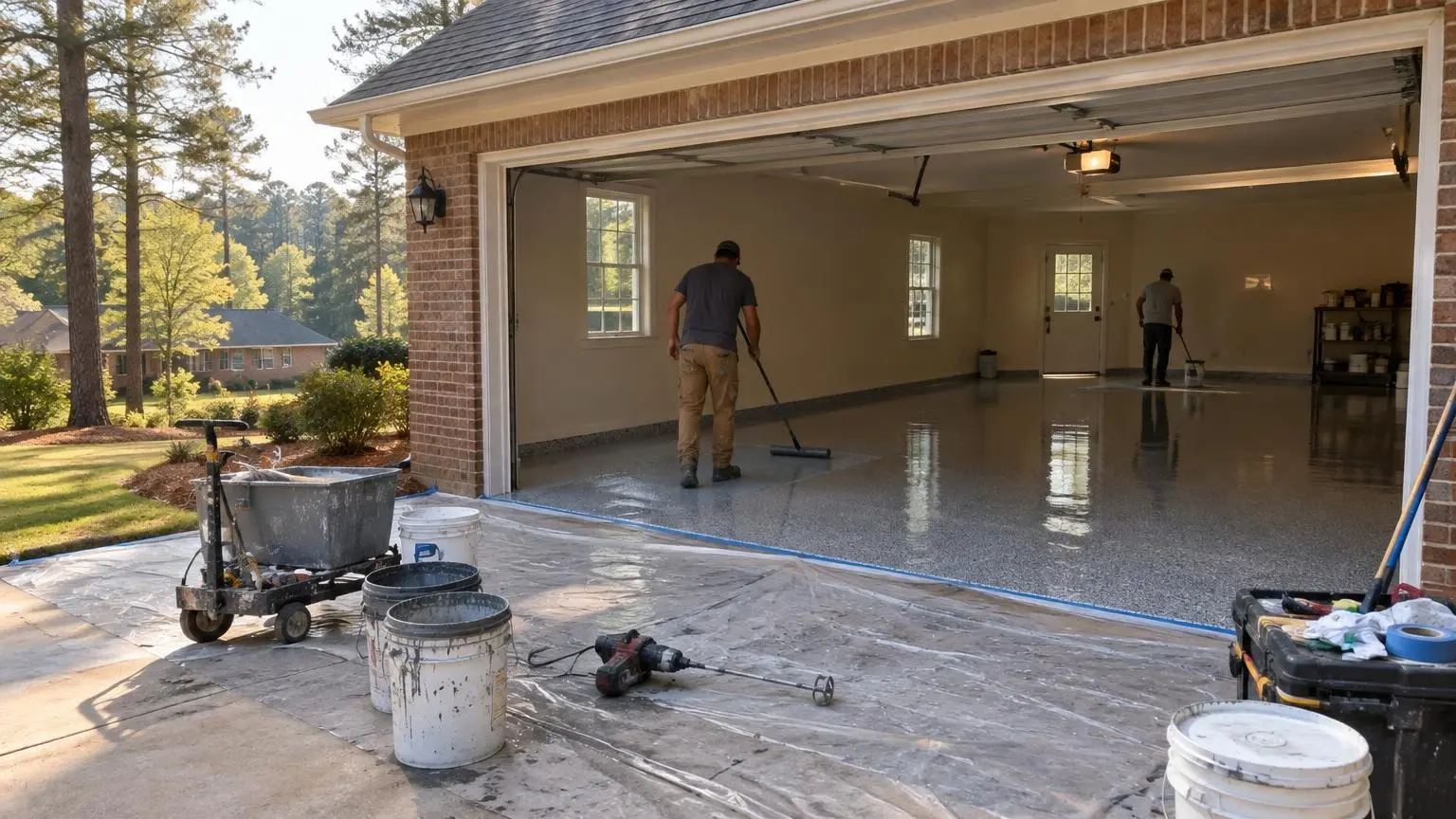
Garage floor coating for metro Atlanta homes
Epoxy Garage Floors in Atlanta, GA
From one-car bungalow garages to three-bay suburban garages, coated for wet tires, summer heat and hard use.
- Free on-site estimates, with the floor measured in person
- Moisture testing on the slab before any coating is chosen
- Written quotes that list each prep step, coat and cost
A Garage Floor That Holds Up to Georgia Use
Epoxy garage floors in Atlanta have to cope with more than a parked car. Tires come in wet on about 116 rainy days a year, summer air is thick with moisture, and a lot of garages double as a gym, a workshop, a storage room or a place to charge a golf cart. A good epoxy garage floor seals the concrete, sheds oil and road grime, and makes the room easier to clean and brighter to work in. A bad one peels at the tire lines within a couple of years. The difference is almost always in the preparation and the timing, not the brand on the bucket.
What a garage floor coating actually is
A garage floor coating is a resin system bonded to bare concrete. In most of our garages that means a primer or base coat of epoxy, an optional broadcast of vinyl chips, and a clear topcoat. Epoxy is the workhorse: it builds thickness, fills small pores and grips ground concrete well. The topcoat is where garages differ. Atlanta garage doors open onto bright afternoon sun, and standard epoxy does not like ultraviolet light. In HomeGuide's comparison table, epoxy scores only poor to fair for sunlight. On any garage where sunlight hits the floor, we finish with polyaspartic, which handles UV and abrasion much better.
Why garage floor epoxy fails, and how we avoid it
Most peeling garage floors we see share one of three causes. The first is poor preparation. Acid etching and a quick rinse leave a weak, dusty surface, and many store kits rely on it. We diamond grind every slab, vacuum it, and fill cracks and pitted spots so the primer bonds to sound concrete. The second is moisture. Garages on sloped lots, or with soil packed against one wall, can push water vapor up through the slab, and that pressure lifts coatings from below. We test for it at the estimate. The third is weather on install day. With average July dew points of 67.8 F, a cool slab on a muggy morning can collect a film of condensation. We read the slab and the air before every coat and wait when the numbers are too close.
Old intown garages and newer suburban slabs
Atlanta's streetcar-era neighborhoods were built between the 1890s and the 1930s, and many bungalows still have a small detached garage behind the house. Those floors are often thin, patched, stained with decades of oil, and painted at least once. Paint has to come off completely, and deep oil spots may need extra grinding or a cleaner before primer. In the suburbs that boomed in recent decades, the concrete is usually newer and flatter but may still have a curing compound or construction sealer on top. Water beading on the surface is a sign of it. Grinding removes it either way.
Matching the system to what lives in your garage
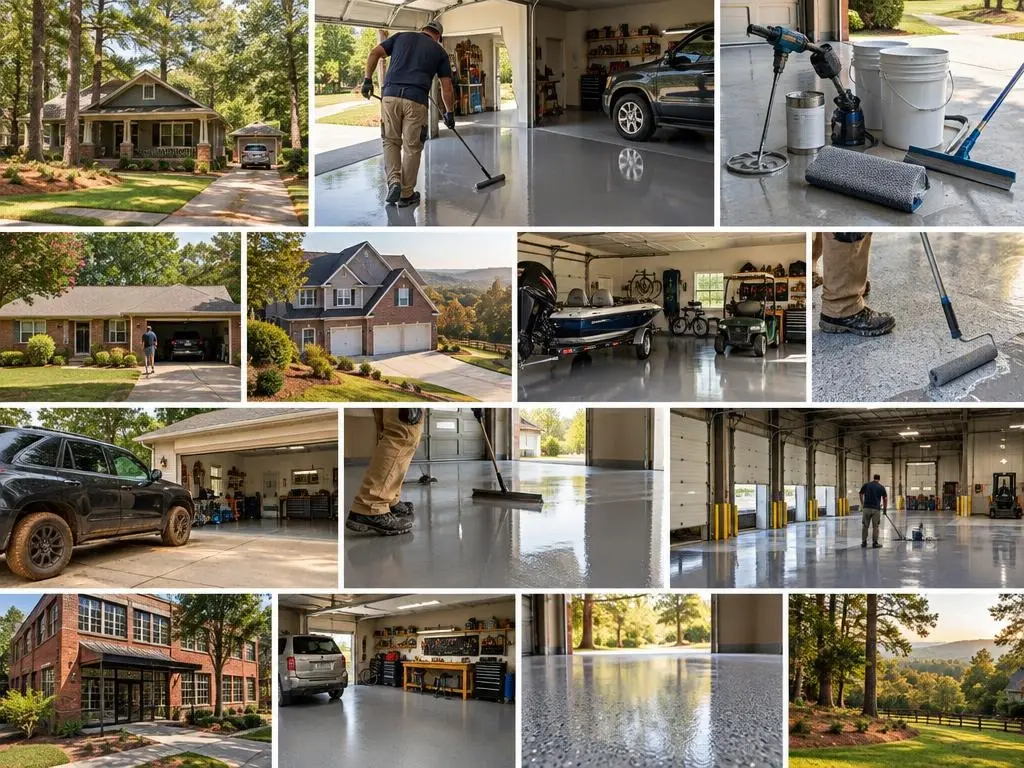
A garage that holds two cars and some bikes needs a different floor than one with a trailered bass boat, a golf cart plugged in overnight, or a full woodworking shop. Trailer jacks and kickstands press heavy loads into a tiny contact area. Rolling toolboxes and floor jacks scrape. Fuel, brake fluid and battery acid stain or soften weaker coatings. For heavier use we go thicker on the base, use a full chip broadcast for impact and texture, and pick a topcoat with better chemical resistance. For a clean, lightly used garage, a thinner two-coat system can make sense. We explain why we chose what we chose.
Timing and cure
A garage floor is usually a one or two day job depending on size, repairs and the system. HomeGuide notes that epoxy needs about 2 to 7 days before you drive on it, while polyaspartic often takes the weight of heavy vehicles after just 24 to 48 hours. Foot traffic, shelving and the car each get their own go-ahead time from us, set by the materials used and the warmth and humidity of install day. If you are planning around a move, a party or a trip, tell us at the estimate and we will plan the system and the schedule around it.
Winter matters less, but it still counts
Atlanta is not a snow city, averaging about 2.2 inches a winter, but lows hit freezing on roughly 36 nights a year and ice storms cause more trouble here than snow. When roads are treated, brine and grit ride in on the tires and sit in puddles under the car. Bare concrete soaks that up. A sealed coating holds it on top, so a squeegee and a hose can clear it away. Garages with a slight slope toward the door make that cleanup easier, and we keep the existing slope in mind when we fill low spots.
Getting a garage quote
We measure the garage, test the slab, note every crack and stain, and talk through what the garage is used for. Afterward a written quote lists each step and coat. Call (470) 873-8205 to set up a time.
Garage Floor Options
Every garage gets ground, repaired and tested. From there, these are the choices we talk through with you.
Solid-color epoxy with polyaspartic topcoat
A clean, uniform color with a clear UV-stable top layer. Good for lightly used garages and home gyms.
Full chip broadcast
Vinyl chips thrown to refusal into the base coat, then sealed. Hides dirt, adds texture and takes impact well.
Crack and joint repair
Cracks, chipped control joints and pitted areas filled and ground flush before any coating goes down.
Old coating and paint removal
Peeling paint, failed kits and old sealers ground away down to raw concrete, giving the new system something to grip.
Moisture-tolerant primer
Used when readings show the slab is giving off more vapor than a standard primer can handle.
Anti-slip texture
Fine aggregate added to the topcoat for garages where wet tires and wet shoes are a daily thing.
Typical Epoxy Garage Floor Costs
| Item | Published range | Source |
|---|---|---|
| Installed epoxy, per square foot | $4 to $10 | HomeGuide |
| One-car garage | $1,200 to $3,900 | HomeGuide |
| Two-car garage | $1,600 to $5,800 | HomeGuide |
| Three-car garage | $2,300 to $8,600 | HomeGuide |
| Two-car garage, polyaspartic | $2,000 to $6,900 | HomeGuide |
| Patching cracks and chips | $25 to $250 | This Old House |
These ranges come from national cost guides, not Atlanta quotes. Paint removal, repairs and your chosen finish all shift the total. The amount on the written estimate we hand you is the real price.
How a Garage Job Goes
1. Estimate and moisture test
We measure, test the slab, and look at stains, cracks, old coatings and how the garage is used.
2. Grind and clean
We diamond grind and vacuum the slab, then degrease any oil-soaked spots.
3. Repair
Cracks, joints and pits are filled and ground smooth.
4. Base, chips and topcoat
Each coat follows a slab temperature and dew point reading, with chips broadcast when your system calls for them.
5. Cure guidance
Separate go-ahead times for feet, shelving and cars, set by the materials and the weather.
Why Choose Us for Epoxy Garage Floors
Grinding on every garage
No acid etch shortcuts. Ground concrete is what lets the coating hold at the tire lines.
Sun-aware topcoats
Where afternoon sun reaches in through the door, a polyaspartic topcoat keeps the floor from yellowing.
Built for how you use it
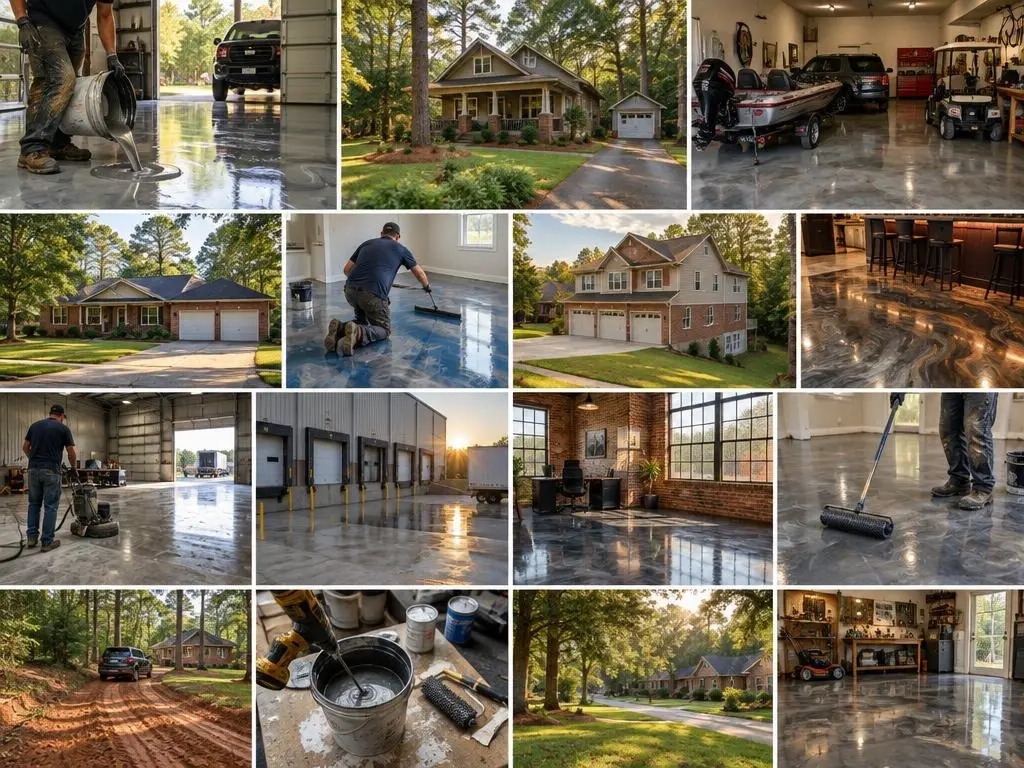
Boats, carts, shops and home gyms each get a system thickness and texture that fits.
Epoxy Garage Floors Questions
Why did my store-bought garage kit peel?
Most kits rely on acid etching or just cleaning, which leaves a weak surface. Hot tires then pull the coating up. Water-based kits are also thin; HomeGuide puts their life at 3 to 5 years versus 10 to 20 for a solid system. We grind the old kit off and start from bare concrete.
Is garage floor epoxy slippery when wet?
A smooth gloss finish can be. Chips or a gritty additive mixed into the final layer fix that for garages where wet tires and shoes come in often.
Can you coat my garage if the slab has cracks?
Usually yes. Hairline and non-moving cracks are filled and ground before coating. A crack that keeps widening or a slab that is lifting needs a different repair first, and we point it out if we find one.
Will hot tires damage the coating?
Hot tire pickup happens mostly with thin coatings on poorly prepared floors. A ground slab, a proper primer and a polyaspartic topcoat resist it well.
Do I need to empty the garage?
Yes, the floor has to be fully clear for grinding and coating. Plan for the garage to be out of use until we tell you it is ready for vehicles.
Epoxy Garage Floors Service Areas
- Epoxy Flooring in Atlanta, GA
- Epoxy Flooring in Buckhead, GA
- Epoxy Flooring in Sandy Springs, GA
- Epoxy Flooring in Dunwoody, GA
- Epoxy Flooring in Brookhaven, GA
- Epoxy Flooring in Decatur, GA
- Epoxy Flooring in Roswell, GA
- Epoxy Flooring in Alpharetta, GA
- Epoxy Flooring in Johns Creek, GA
- Epoxy Flooring in Milton, GA
- Epoxy Flooring in Marietta, GA
- Epoxy Flooring in Smyrna, GA
- Epoxy Flooring in Kennesaw, GA
- Epoxy Flooring in Peachtree Corners, GA
- Epoxy Flooring in Duluth, GA
- Epoxy Flooring in Lawrenceville, GA
- Epoxy Flooring in Suwanee, GA
- Epoxy Flooring in Tucker, GA
- Epoxy Flooring in Peachtree City, GA
- Epoxy Flooring in Fayetteville, GA
- Epoxy Flooring in Newnan, GA
- Epoxy Flooring in Douglasville, GA
- Epoxy Flooring in Canton, GA
- Epoxy Flooring in Woodstock, GA
- Epoxy Flooring in Cumming, GA
Get an Epoxy Garage Floors Estimate
Free garage estimates with a slab moisture test and a written quote. Call (470) 873-8205.