
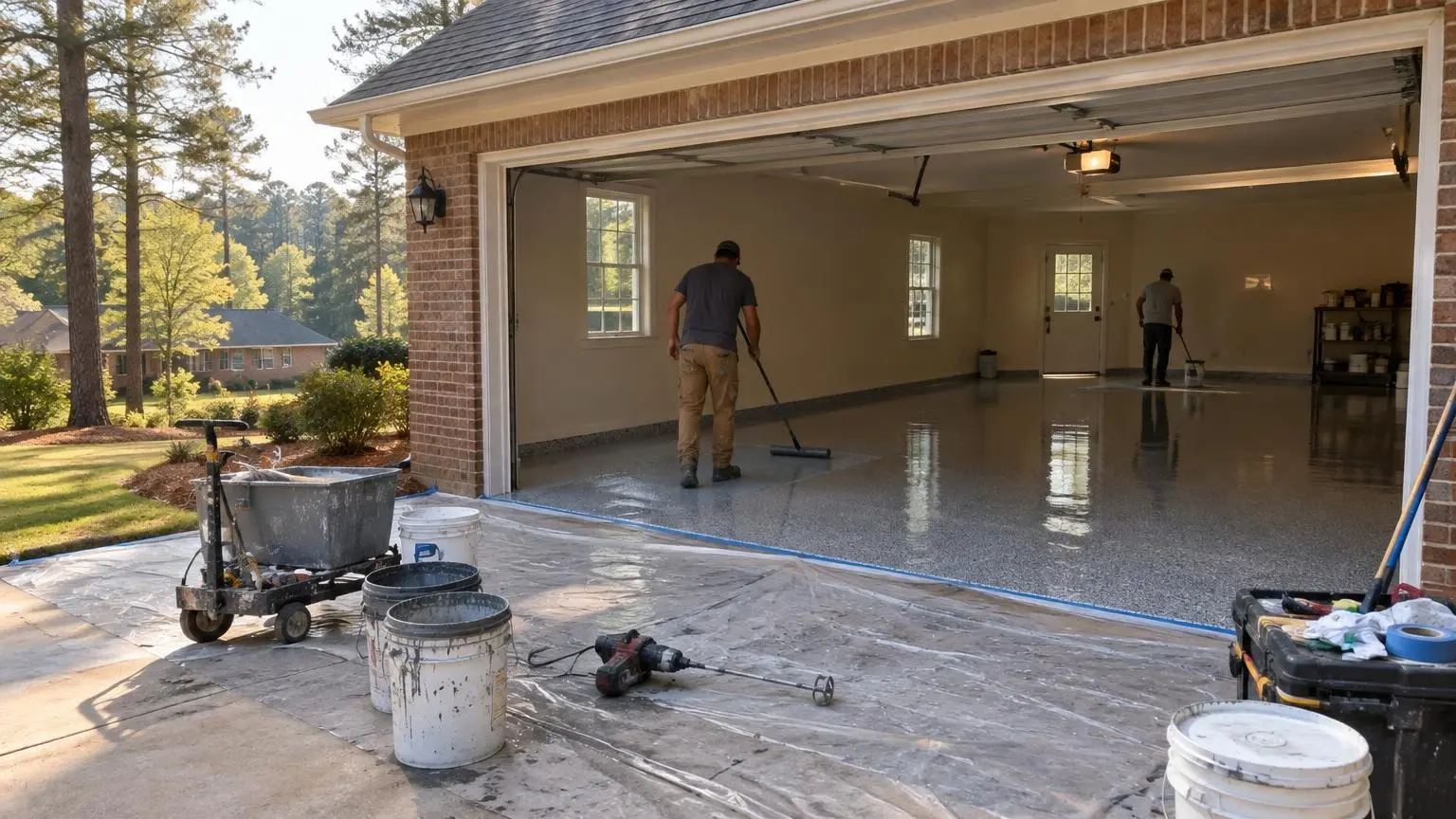
Polyaspartic floor coating, explained plainly
Polyaspartic Coatings in Atlanta, GA
A tougher, sun-stable topcoat or full system that gets you back on your floor in days, not a week.
- Free on-site estimates, with the floor measured in person
- Moisture testing on the slab before any coating is chosen
- Written quotes that list each prep step, coat and cost
Polyaspartic vs. Epoxy for Atlanta Floors
Polyaspartic coatings come up in almost every Atlanta estimate we do, usually as a question: is it better than epoxy? The honest answer is that they do different jobs, and many well-built garage floors use both. Chemically, a polyaspartic floor coating belongs to the polyurea family, in a form that does not darken in light. Compared with standard epoxy, it holds its color in sunlight, resists abrasion and chemicals well, and cures much faster. It is also less forgiving to install, which is one reason it is not sold as a weekend kit.
Sunlight is the main reason
Sunlight is where the two chemistries split most clearly. HomeGuide grades polyaspartic excellent for UV, and epoxy only poor to fair. Epoxy exposed to daylight can amber, yellow or chalk over time. That matters in Atlanta, where many garages face west into strong afternoon sun and the door stays open for hours on summer weekends. It matters even more for floors that are partly outdoors, like a covered porch or a carport. Wherever UV reaches the floor, we use a polyaspartic topcoat at minimum.
Faster return to service
According to HomeGuide, a polyaspartic floor is usually fully cured in one to two days and can carry heavy vehicles once 24 to 48 hours have passed, with epoxy, by contrast, sometimes taking a week. Bob Vila's guide puts foot traffic on polyaspartic at 3 to 4 hours and cars at roughly 24. For a family with one garage and two cars, that is the difference between a weekend and a week of parking in the driveway. For a business, it can mean closing for a day instead of several.
Thin coats, fast set, careful timing
Polyaspartic goes on thinner than epoxy, HomeGuide lists it at 2 to 6 mils a layer, where epoxy lays down 10 to 20. It sets quickly, and in Atlanta summer heat the working time in the bucket gets shorter still. So we mix only small amounts at a time, lay it out in planned sections and keep a close eye on temperature and humidity. Because it is thin, polyaspartic does not fill pores and low spots the way epoxy does, so the grinding and repair under it have to be right. On many floors we use an epoxy or moisture-tolerant primer for build and bond, then polyaspartic on top.
Humidity and polyaspartic
Polyaspartic chemistry reacts with moisture in the air, and some formulas speed up in humid weather. With average summer dew points in the mid to upper 60s here, we pick products and mixing ratios that suit the conditions on the day. We also check the slab temperature against the dew point before each coat, the same as with epoxy. If condensation is likely, we wait.
Full system or topcoat only
A full polyaspartic system uses polyaspartic for the base and the topcoat, often with chips broadcast between. It is the fastest option and very UV-stable, but it costs more. A hybrid pairs a thick epoxy first layer with a polyaspartic wear surface. You get epoxy's thickness and bond with polyaspartic's sun and wear resistance on the surface. For a typical attached garage, the hybrid is often the better value. For a sunny detached garage or a floor that needs to be back in use the next day, a full polyaspartic system makes more sense. We will tell you which we recommend and why.
Where polyaspartic earns its price
Expect polyaspartic to carry a higher per-square-foot price than epoxy. HomeGuide lists polyaspartic at $5 to $12 against $4 to $10 for epoxy. It is worth it in a few clear cases: a garage that gets direct afternoon sun, a covered porch or carport, a floor that must be back in service the next day, or a space with a lot of abrasion from carts, dollies and tools. It is less necessary in a dark interior room that never sees sunlight, such as a windowless storage area, where an epoxy topcoat can do the job. We will tell you which case your floor falls into rather than upselling a full system you do not need.
Porches, carports and breezeways
Not every floor that sees sun is a garage. Covered porches, carports, breezeways between a house and a detached garage, and screened rooms all sit on concrete that gets direct light for part of the day and blowing rain from the side. Epoxy on its own is a poor fit for these spots because of how it reacts to UV. A clear or tinted polyaspartic coat, with chips or grit for footing, suits them better. We still grind first, check that water drains off the slab rather than pooling, and look at the edges where soil, mulch or pine straw meet the concrete, since those edges stay damp longest after a storm.
What to ask any installer about polyaspartic
Ask whether the quote is for a full polyaspartic system or only a polyaspartic topcoat. Ask how many coats and how thick. Ask how they handle working time in heat and humidity. A clear answer to each, in writing, is a good sign. Call (470) 873-8205 for ours.
Polyaspartic Options
Where polyaspartic fits, and the ways we use it.
Polyaspartic topcoat over epoxy
Thick epoxy underneath for fill and grip, a clear sun-stable polyaspartic layer on top. Our common garage system.
Full polyaspartic system
Polyaspartic from base to topcoat, for the quickest cure and the most UV resistance.
Polyaspartic with chip broadcast
Vinyl chips locked between polyaspartic coats for texture and impact resistance.
Clear sealer for porches and carports
A clear polyaspartic coat for partly outdoor concrete that sees direct sun.
Fast-return commercial floors
Systems planned so a shop or retail floor can reopen sooner after coating.
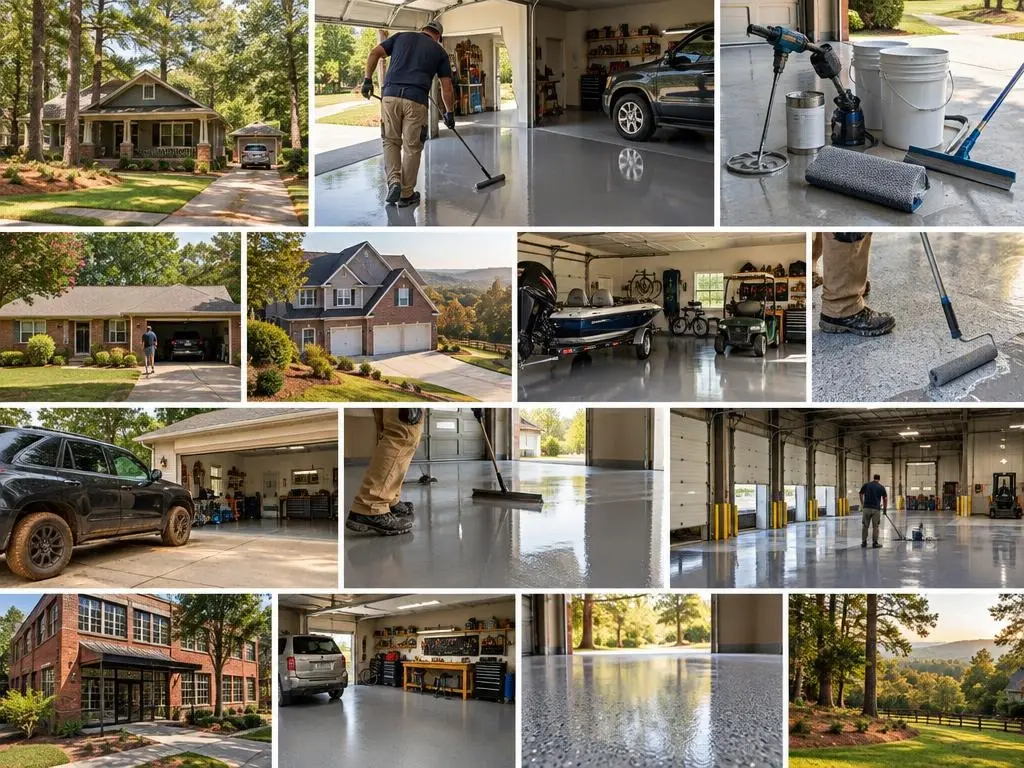
Typical Polyaspartic Coating Costs
| Item | Published range | Source |
|---|---|---|
| Polyaspartic, per square foot | $5 to $12 | HomeGuide |
| One-car garage | $1,400 to $4,700 | HomeGuide |
| Two-car garage | $2,000 to $6,900 | HomeGuide |
| Three-car garage | $2,900 to $10,400 | HomeGuide |
| Typical project | $1,440 to $3,240 | Bob Vila |
These are national figures from cost guides. Whether you choose a full polyaspartic system or a topcoat over epoxy, plus prep and repairs, sets the real number. The written estimate we give you is the price.
How a Polyaspartic Job Runs
1. Test and plan
We test the slab, check sun exposure and decide between a full system and a hybrid.
2. Grind and repair
Thin polyaspartic coats need a well-ground, fully repaired surface underneath.
3. Base coat
Epoxy, moisture-tolerant primer or polyaspartic base, with chips if chosen.
4. Polyaspartic topcoat
Mixed in small batches and applied in sections after a temperature and dew point check.
5. Fast return
We give you walk and drive times for the product used, frequently the next day.
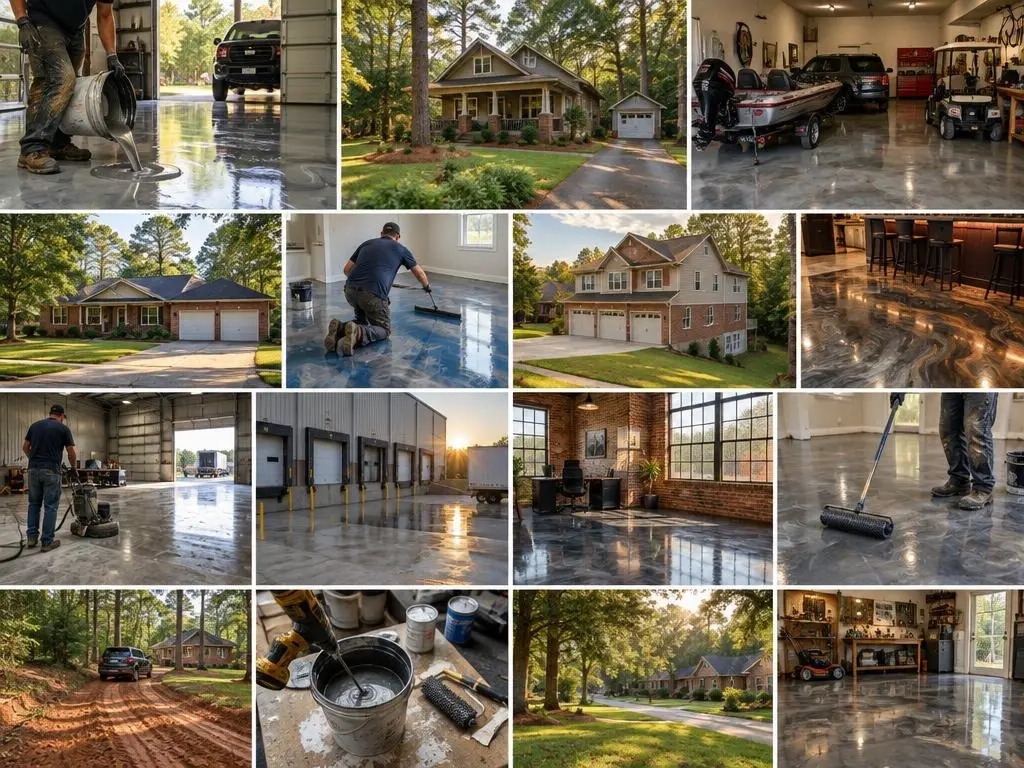
Why Choose Us for Polyaspartic Coatings
Straight answers on chemistry
Your quote says exactly which layers are epoxy and which are polyaspartic.
Heat and humidity planning
Small batches and day-of readings keep a fast-setting product from setting too fast.
Prep matched to thin coats
Because polyaspartic is thin, we take extra care with grinding and repairs.
Polyaspartic Coatings Questions
Is polyaspartic better than epoxy?
For sun, abrasion and cure speed, yes. Epoxy builds thicker and is easier to apply. Putting polyaspartic over an epoxy first layer is a common way to get the strengths of each.
When can the car go back on a polyaspartic floor?
HomeGuide says heavy vehicle traffic is usually fine after 24 to 48 hours. We set the exact time for your floor from the product used and the temperature and humidity on install day.
Can I install polyaspartic myself?
Bob Vila's guide says it is not a DIY product. It sets fast and thin, so mistakes are hard to fix before it hardens.
How many years will a polyaspartic floor hold up?
HomeGuide puts the life of a polyaspartic floor at 10 to 20 years or more. Slab preparation and moisture conditions underneath affect that more than anything.
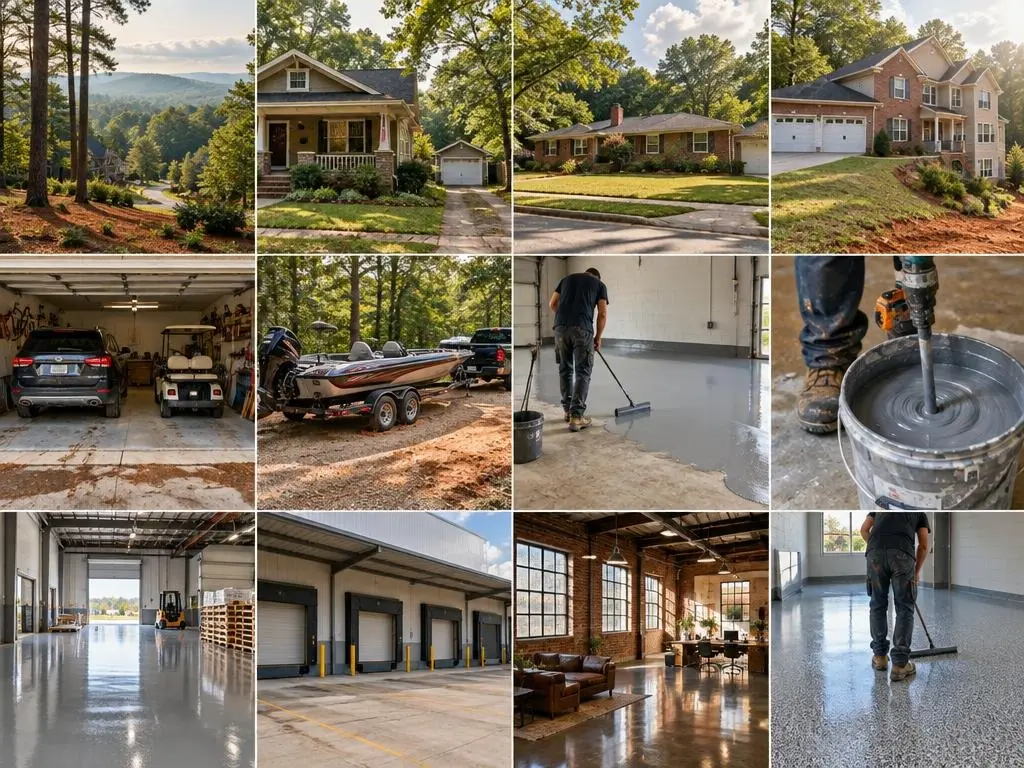
Polyaspartic Coatings Service Areas
- Epoxy Flooring in Atlanta, GA
- Epoxy Flooring in Buckhead, GA
- Epoxy Flooring in Sandy Springs, GA
- Epoxy Flooring in Dunwoody, GA
- Epoxy Flooring in Brookhaven, GA
- Epoxy Flooring in Decatur, GA
- Epoxy Flooring in Roswell, GA
- Epoxy Flooring in Alpharetta, GA
- Epoxy Flooring in Johns Creek, GA
- Epoxy Flooring in Milton, GA
- Epoxy Flooring in Marietta, GA
- Epoxy Flooring in Smyrna, GA
- Epoxy Flooring in Kennesaw, GA
- Epoxy Flooring in Peachtree Corners, GA
- Epoxy Flooring in Duluth, GA
- Epoxy Flooring in Lawrenceville, GA
- Epoxy Flooring in Suwanee, GA
- Epoxy Flooring in Tucker, GA
- Epoxy Flooring in Peachtree City, GA
- Epoxy Flooring in Fayetteville, GA
- Epoxy Flooring in Newnan, GA
- Epoxy Flooring in Douglasville, GA
- Epoxy Flooring in Canton, GA
- Epoxy Flooring in Woodstock, GA
- Epoxy Flooring in Cumming, GA
Get a Polyaspartic Coatings Estimate
Ask us whether a full polyaspartic system or a hybrid fits your floor. Free estimates at (470) 873-8205.